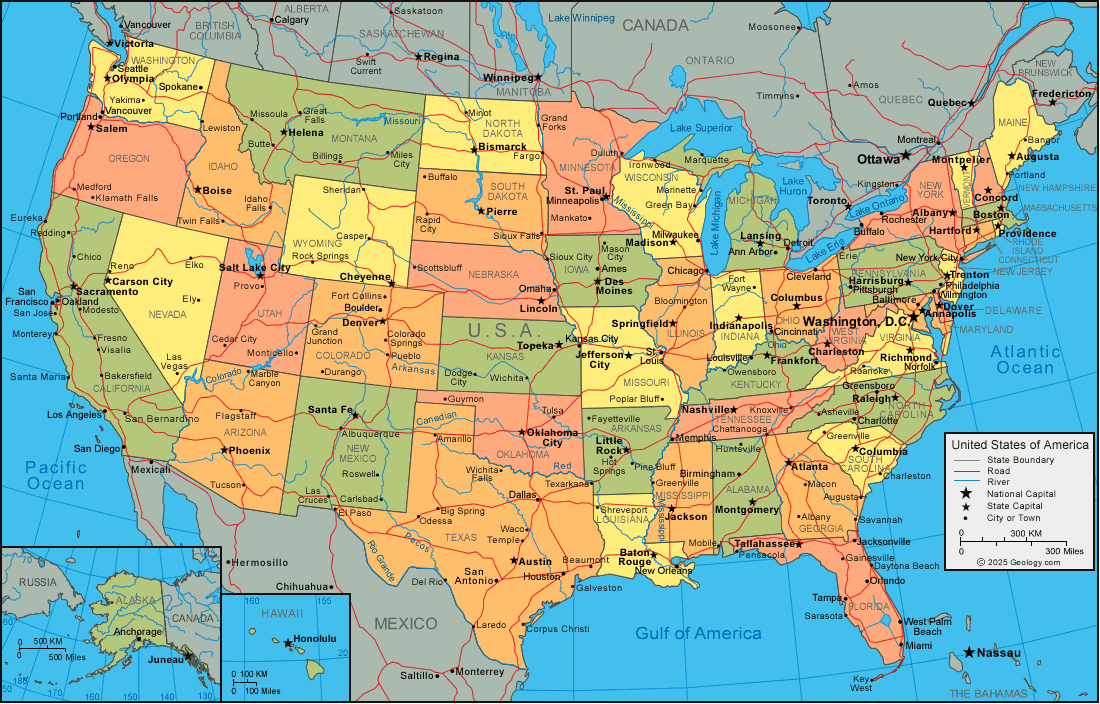
Southern Rocky MountainsThe High Plains are a subregion of the Great Plains in the central United States, located in eastern Colorado, western Kansas, western Nebraska, central and eastern Montana, eastern New Mexico, western Oklahoma, northwestern Texas, and southeastern Wyoming. In some definitions of the subregion, parts of western South Dakota and North Dakota are included. From east to west, the High Plains rise in elevation from around 750 m (2500 ft) to over 1800 m (6000 ft).
The High Plains are semiarid, receiving between 250–500 mm (10–20 in) of precipitation annually. Shortgrass prairie and scrub vegetation cover the region, with occasional buttes or other rocky outcrops. Agriculture in the forms of cattle ranching and the growing of wheat, cotton and sunflowers is the primary economic activity in the region. The aridity of the region necessitates either dryland farming methods or irrigation; much water for irrigation is drawn from the underlying Ogallala Aquifer. Some areas have significant petroleum and natural gas deposits.
The High Plains has one of the lowest population densities of any region in the continental United States; Wyoming, for example, has the second lowest population density in the country before Alaska. In contrast to the rather low and stagnant population in northern and western High Plains, cities in west Texas have shown sustained growth. Amarillo and Lubbock, Texas both exceed populations of 200,000. Smaller towns often struggle to sustain their population.
Friday, April 25, 2008

Miami, Florida
It is an international center for popular entertainment in television, music, fashion, film and the performing arts. The city's Port of Miami is known for accommodating the largest volume of cruise ships in the world and is home to many cruise line headquarters.
Dallas, Texas
One major art infusion in the area is the city's lax stance on graffiti; consequently, several public ways including tunnels, sides of buildings, sidewalks, and streets are covered in murals. Today, Deep Ellum is home to hundreds of artists who live in lofts and operate in studios throughout the district alongside bars, pubs, and concert venues. The Cedars has a growing population of studio artists and an expanding roster of entertainment venues. The area's art scene began to grow in the early 2000s with the opening of Southside on Lamar, a Sears warehouse converted into lofts, studios, and retail.
New Orleans, Louisiana
worst civil engineering disaster in American history
80% of the city flooded
56% of the pre-Katrina population
80% of the city flooded
56% of the pre-Katrina population
Detroit, Michigan
Detroit area is the only major U.S. city that looks south to Canada. It is known as the world's traditional automotive center. Popular local bands producing and performing music included artists like: the MC5, The Stooges, Bob Seger, Amboy Dukes featuring Ted Nugent, Mitch Ryder and The Detroit Wheels, Rare Earth, Alice Cooper. The city also has an active garage rock scene that has generated national attention with acts such as: The White Stripes, The Von Bondies, The Dirtbombs, Electric Six, and more recently by bands like The Hard Lessons and former P-Funk Allstar drummer Gabe Gonzalez's Funk Band The Enemy Squad. Detroit hip hop rose to prominence in the late nineties with the emergence of Eminem, Slum Village, D12, J Dilla, Obie Trice, Proof, and Esham.
a top 50 list
Popular Destinations in United States of America
1. New York City
2. San Francisco
3. Las Vegas
4. Chicago
5. Los Angeles
6. Boston
7. San Diego
8. New Orleans
9. Seattle
10. Orlando
11. Philadelphia
12. Honolulu
13. Dallas
14. Houston
15. Atlanta
16. San Antonio
17. Miami
18. Key West
19. Baltimore
20. Portland
21. Austin
22. Yosemite National Park
23. Grand Canyon
24. Denver
25. Saint Louis
26. Minneapolis
27. Yellowstone National Park
28. Miami Beach
29. Monterey
30. Phoenix
31. Tampa
32. Death Valley National Park
33. Tucson
34. Cincinnati
35. Detroit
36. Fort Worth
37. Pittsburgh
38. Anchorage
39. Savannah
40. Charleston
41. Saint Augustine
42. Kansas City
43. Memphis
44. Albuquerque
45. Richmond
46. Cleveland
47. Indianapolis
48. Salt Lake City
49. Sacramento
50. Niagara Falls
1. New York City
2. San Francisco
3. Las Vegas
4. Chicago
5. Los Angeles
6. Boston
7. San Diego
8. New Orleans
9. Seattle
10. Orlando
11. Philadelphia
12. Honolulu
13. Dallas
14. Houston
15. Atlanta
16. San Antonio
17. Miami
18. Key West
19. Baltimore
20. Portland
21. Austin
22. Yosemite National Park
23. Grand Canyon
24. Denver
25. Saint Louis
26. Minneapolis
27. Yellowstone National Park
28. Miami Beach
29. Monterey
30. Phoenix
31. Tampa
32. Death Valley National Park
33. Tucson
34. Cincinnati
35. Detroit
36. Fort Worth
37. Pittsburgh
38. Anchorage
39. Savannah
40. Charleston
41. Saint Augustine
42. Kansas City
43. Memphis
44. Albuquerque
45. Richmond
46. Cleveland
47. Indianapolis
48. Salt Lake City
49. Sacramento
50. Niagara Falls
American football is the most popular spectator sport in the United States. It is a combat game where highly trained athletes skillfully and brutally execute strategic plans. Attending a football game often begins with a "tailgate party" in the parking lot of the stadium followed by several hours of rowdy, emotionally charged excitement. Most fans watch football while gathered in a local bar or at a friend's home in front of a big-screen TV.
The Indian reservations are actually sovereign nations within the United States of America. They govern themselves; maintain their own police force and their own system of justice. When you visit a reservation, you are under the laws of the tribe. Some Indian tribes have taken advantage of this independent political status by allowing gambling on their reservations while the states around them prohibit it. Indian casinos now attract many tourists from the surrounding no-gambling states. On some reservations, the tribes also sell cigarettes, alcohol or gasoline at reduced prices due to their exemption from state taxes.
The Indian reservation is the spiritual and cultural center for all members of the tribe including those living far from it. The native language, the cultural traditions and the religious ceremonies are typically preserved by the tribal members living on the reservation. Unfortunately, you will not get much chance to experience Indian culture by visiting the Indian casino or by purchasing cheap cigarettes in the reservation store. Most of the authentic religious ceremonies and cultural events are not open to the public.
The Indian reservation is the spiritual and cultural center for all members of the tribe including those living far from it. The native language, the cultural traditions and the religious ceremonies are typically preserved by the tribal members living on the reservation. Unfortunately, you will not get much chance to experience Indian culture by visiting the Indian casino or by purchasing cheap cigarettes in the reservation store. Most of the authentic religious ceremonies and cultural events are not open to the public.
The Number of Countries in the World
Mar 18 2008
A very frequent geographical question is "How many countries are in the world?" Different numbers pop up when one inquires or reads about the number of countries in the world. Each source you use often yields a different answer. Ultimately, the best answer is that there are 195 countries in the world.
United Nations
There are 192 members of the United Nations. Unfortunately, the number 192 is too often used to represent the number of countries in the world. Although this number represents almost all of the countries in the world, there are still two recognized independent countries, the Vatican City and Kosovo, that are independent and are not members of the U.N. so 192 is not the number of countries in the world.
U.S. Department of State
The United States' State Department recognizes 194 independent countries around the world. Their list of 194 countries reflects the political agenda of the United States of America and its allies. Missing from the State Department's list is one entity that may or may not be considered a country, depending on who you talk to.
The One Outsider
Taiwan meets the requirements of independent country or state status. However, due to political reasons, it fails to be recognized by the international community as independent. Nonetheless, it should be considered as independent.
Taiwan was actually a member of the United Nations (and even the Security Council) until 1971, when mainland China replaced Taiwan in the organization. Taiwan continues to press for full recognition by other countries, to become "part of the club" and fully recognized worldwide but China claims that Taiwan is simply a province of China.
Thus...
Your Guide considers there to be 195 countries in the world, which is probably the best current answer to the question, "How many countries are in the world?"
However...
Recognize that there are dozens of territories and colonies that are sometimes erroneously called "countries" but don't count at all - they're governed by other countries. Places commonly confused as being countries include Puerto Rico, Bermuda, Greenland, Palestine, Western Sahara, and even the components of the United Kingdom (such as Northern Ireland, Scotland, Wales, and England - they're not fully independent countries, states, or nation-states).
A very frequent geographical question is "How many countries are in the world?" Different numbers pop up when one inquires or reads about the number of countries in the world. Each source you use often yields a different answer. Ultimately, the best answer is that there are 195 countries in the world.
United Nations
There are 192 members of the United Nations. Unfortunately, the number 192 is too often used to represent the number of countries in the world. Although this number represents almost all of the countries in the world, there are still two recognized independent countries, the Vatican City and Kosovo, that are independent and are not members of the U.N. so 192 is not the number of countries in the world.
U.S. Department of State
The United States' State Department recognizes 194 independent countries around the world. Their list of 194 countries reflects the political agenda of the United States of America and its allies. Missing from the State Department's list is one entity that may or may not be considered a country, depending on who you talk to.
The One Outsider
Taiwan meets the requirements of independent country or state status. However, due to political reasons, it fails to be recognized by the international community as independent. Nonetheless, it should be considered as independent.
Taiwan was actually a member of the United Nations (and even the Security Council) until 1971, when mainland China replaced Taiwan in the organization. Taiwan continues to press for full recognition by other countries, to become "part of the club" and fully recognized worldwide but China claims that Taiwan is simply a province of China.
Thus...
Your Guide considers there to be 195 countries in the world, which is probably the best current answer to the question, "How many countries are in the world?"
However...
Recognize that there are dozens of territories and colonies that are sometimes erroneously called "countries" but don't count at all - they're governed by other countries. Places commonly confused as being countries include Puerto Rico, Bermuda, Greenland, Palestine, Western Sahara, and even the components of the United Kingdom (such as Northern Ireland, Scotland, Wales, and England - they're not fully independent countries, states, or nation-states).
capitols of every country in the world
Afghanistan - Kabul
Albania - Tirane
Algeria - Algiers
Andorra - Andorra la Vella
Angola - Luanda
Antigua and Barbuda - Saint John's
Argentina - Buenos Aires
Armenia - Yerevan
Australia - Canberra
Austria - Vienna
Azerbaijan - Baku
The Bahamas - Nassau
Bahrain - Manama
Bangladesh - Dhaka
Barbados - Bridgetown
Belarus - Minsk
Belgium - Brussels
Belize - Belmopan
Benin - Porto-Novo
Bhutan - Thimphu
Bolivia - La Paz (administrative); Sucre (judicial)
Bosnia and Herzegovina - Sarajevo
Botswana - Gaborone
Brazil - Brasilia
Brunei - Bandar Seri Begawan
Bulgaria - Sofia
Burkina Faso - Ouagadougou
Burundi - Bujumbura
Cambodia - Phnom Penh
Cameroon - Yaounde
Canada - Ottawa
Cape Verde - Praia
Central African Republic - Bangui
Chad - N'Djamena
Chile - Santiago
China - Beijing
Colombia - Bogota
Comoros - Moroni
Congo, Republic of the - Brazzaville
Congo, Democratic Republic of the - Kinshasa
Costa Rica - San Jose
Cote d'Ivoire - Yamoussoukro (official); Abidjan (de facto)
Croatia - Zagreb
Cuba - Havana
Cyprus - Nicosia
Czech Republic - Prague
Denmark - Copenhagen
Djibouti - Djibouti
Dominica - Roseau
Dominican Republic - Santo Domingo
East Timor (Timor-Leste) - Dili
Ecuador - Quito
Egypt - Cairo
El Salvador - San Salvador
Equatorial Guinea - Malabo
Eritrea - Asmara
Estonia - Tallinn
Ethiopia - Addis Ababa
Fiji - Suva
Finland - Helsinki
France - Paris
Gabon - Libreville
The Gambia - Banjul
Georgia - Tbilisi
Germany - Berlin
Ghana - Accra
Greece - Athens
Grenada - Saint George's
Guatemala - Guatemala City
Guinea - Conakry
Guinea-Bissau - Bissau
Guyana - Georgetown
Haiti - Port-au-Prince
Honduras - Tegucigalpa
Hungary - Budapest
Iceland - Reykjavik
India - New Delhi
Indonesia - Jakarta
Iran - Tehran
Iraq - Baghdad
Ireland - Dublin
Israel - Jerusalem
Italy - Rome
Jamaica - Kingston
Japan - Tokyo
Jordan - Amman
Kazakhstan - Astana
Kenya - Nairobi
Kiribati - Tarawa Atoll
Korea, North - Pyongyang
Korea, South - Seoul
Kosovo - Pristina
Kuwait - Kuwait City
Kyrgyzstan - Bishkek
Laos - Vientiane
Latvia - Riga
Lebanon - Beirut
Lesotho - Maseru
Liberia - Monrovia
Libya - Tripoli
Liechtenstein - Vaduz
Lithuania - Vilnius
Luxembourg - Luxembourg
Macedonia - Skopje
Madagascar - Antananarivo
Malawi - Lilongwe
Malaysia - Kuala Lumpur
Maldives - Male
Mali - Bamako
Malta - Valletta
Marshall Islands - Majuro
Mauritania - Nouakchott
Mauritius - Port Louis
Mexico - Mexico City
Micronesia, Federated States of - Palikir
Moldova - Chisinau
Monaco - Monaco
Mongolia - Ulaanbaatar
Montenegro - Podgorica
Morocco - Rabat
Mozambique - Maputo
Myanmar (Burma) - Rangoon (Yangon); Nay Pyi Taw (administrative)
Namibia - Windhoek
Nauru - no official capital; government offices in Yaren District
Nepal - Kathmandu
Netherlands - Amsterdam; The Hague (seat of government)
New Zealand - Wellington
Nicaragua - Managua
Niger - Niamey
Nigeria - Abuja
Norway - Oslo
Oman - Muscat
Pakistan - Islamabad
Palau - Melekeok
Panama - Panama City
Papua New Guinea - Port Moresby
Paraguay - Asuncion
Peru - Lima
Philippines - Manila
Poland - Warsaw
Portugal - Lisbon
Qatar - Doha
Romania - Bucharest
Russia - Moscow
Rwanda - Kigali
Saint Kitts and Nevis - Basseterre
Saint Lucia - Castries
Saint Vincent and the Grenadines - Kingstown
Samoa - Apia
San Marino - San Marino
Sao Tome and Principe - Sao Tome
Saudi Arabia - Riyadh
Senegal - Dakar
Serbia - Belgrade
Seychelles - Victoria
Sierra Leone - Freetown
Singapore - Singapore
Slovakia - Bratislava
Slovenia - Ljubljana
Solomon Islands - Honiara
Somalia - Mogadishu
South Africa - Pretoria (administrative); Cape Town (legislative); Bloemfontein (judiciary)
Spain - Madrid
Sri Lanka - Colombo; Sri Jayewardenepura Kotte (legislative)
Sudan - Khartoum
Suriname - Paramaribo
Swaziland - Mbabane
Sweden - Stockholm
Switzerland - Bern
Syria - Damascus
Taiwan - Taipei
Tajikistan - Dushanbe
Tanzania - Dar es Salaam; Dodoma (legislative)
Thailand - Bangkok
Togo - Lome
Tonga - Nuku'alofa
Trinidad and Tobago - Port-of-Spain
Tunisia - Tunis
Turkey - Ankara
Turkmenistan - Ashgabat
Tuvalu - Vaiaku village, Funafuti province
Uganda - Kampala
Ukraine - Kyiv
United Arab Emirates - Abu Dhabi
United Kingdom - London
United States of America - Washington D.C.
Uruguay - Montevideo
Uzbekistan - Tashkent
Vanuatu - Port-Vila
Vatican City (Holy See) - Vatican City
Venezuela - Caracas
Vietnam - Hanoi
Yemen - Sanaa
Zambia - Lusaka
Zimbabwe - Harare
Albania - Tirane
Algeria - Algiers
Andorra - Andorra la Vella
Angola - Luanda
Antigua and Barbuda - Saint John's
Argentina - Buenos Aires
Armenia - Yerevan
Australia - Canberra
Austria - Vienna
Azerbaijan - Baku
The Bahamas - Nassau
Bahrain - Manama
Bangladesh - Dhaka
Barbados - Bridgetown
Belarus - Minsk
Belgium - Brussels
Belize - Belmopan
Benin - Porto-Novo
Bhutan - Thimphu
Bolivia - La Paz (administrative); Sucre (judicial)
Bosnia and Herzegovina - Sarajevo
Botswana - Gaborone
Brazil - Brasilia
Brunei - Bandar Seri Begawan
Bulgaria - Sofia
Burkina Faso - Ouagadougou
Burundi - Bujumbura
Cambodia - Phnom Penh
Cameroon - Yaounde
Canada - Ottawa
Cape Verde - Praia
Central African Republic - Bangui
Chad - N'Djamena
Chile - Santiago
China - Beijing
Colombia - Bogota
Comoros - Moroni
Congo, Republic of the - Brazzaville
Congo, Democratic Republic of the - Kinshasa
Costa Rica - San Jose
Cote d'Ivoire - Yamoussoukro (official); Abidjan (de facto)
Croatia - Zagreb
Cuba - Havana
Cyprus - Nicosia
Czech Republic - Prague
Denmark - Copenhagen
Djibouti - Djibouti
Dominica - Roseau
Dominican Republic - Santo Domingo
East Timor (Timor-Leste) - Dili
Ecuador - Quito
Egypt - Cairo
El Salvador - San Salvador
Equatorial Guinea - Malabo
Eritrea - Asmara
Estonia - Tallinn
Ethiopia - Addis Ababa
Fiji - Suva
Finland - Helsinki
France - Paris
Gabon - Libreville
The Gambia - Banjul
Georgia - Tbilisi
Germany - Berlin
Ghana - Accra
Greece - Athens
Grenada - Saint George's
Guatemala - Guatemala City
Guinea - Conakry
Guinea-Bissau - Bissau
Guyana - Georgetown
Haiti - Port-au-Prince
Honduras - Tegucigalpa
Hungary - Budapest
Iceland - Reykjavik
India - New Delhi
Indonesia - Jakarta
Iran - Tehran
Iraq - Baghdad
Ireland - Dublin
Israel - Jerusalem
Italy - Rome
Jamaica - Kingston
Japan - Tokyo
Jordan - Amman
Kazakhstan - Astana
Kenya - Nairobi
Kiribati - Tarawa Atoll
Korea, North - Pyongyang
Korea, South - Seoul
Kosovo - Pristina
Kuwait - Kuwait City
Kyrgyzstan - Bishkek
Laos - Vientiane
Latvia - Riga
Lebanon - Beirut
Lesotho - Maseru
Liberia - Monrovia
Libya - Tripoli
Liechtenstein - Vaduz
Lithuania - Vilnius
Luxembourg - Luxembourg
Macedonia - Skopje
Madagascar - Antananarivo
Malawi - Lilongwe
Malaysia - Kuala Lumpur
Maldives - Male
Mali - Bamako
Malta - Valletta
Marshall Islands - Majuro
Mauritania - Nouakchott
Mauritius - Port Louis
Mexico - Mexico City
Micronesia, Federated States of - Palikir
Moldova - Chisinau
Monaco - Monaco
Mongolia - Ulaanbaatar
Montenegro - Podgorica
Morocco - Rabat
Mozambique - Maputo
Myanmar (Burma) - Rangoon (Yangon); Nay Pyi Taw (administrative)
Namibia - Windhoek
Nauru - no official capital; government offices in Yaren District
Nepal - Kathmandu
Netherlands - Amsterdam; The Hague (seat of government)
New Zealand - Wellington
Nicaragua - Managua
Niger - Niamey
Nigeria - Abuja
Norway - Oslo
Oman - Muscat
Pakistan - Islamabad
Palau - Melekeok
Panama - Panama City
Papua New Guinea - Port Moresby
Paraguay - Asuncion
Peru - Lima
Philippines - Manila
Poland - Warsaw
Portugal - Lisbon
Qatar - Doha
Romania - Bucharest
Russia - Moscow
Rwanda - Kigali
Saint Kitts and Nevis - Basseterre
Saint Lucia - Castries
Saint Vincent and the Grenadines - Kingstown
Samoa - Apia
San Marino - San Marino
Sao Tome and Principe - Sao Tome
Saudi Arabia - Riyadh
Senegal - Dakar
Serbia - Belgrade
Seychelles - Victoria
Sierra Leone - Freetown
Singapore - Singapore
Slovakia - Bratislava
Slovenia - Ljubljana
Solomon Islands - Honiara
Somalia - Mogadishu
South Africa - Pretoria (administrative); Cape Town (legislative); Bloemfontein (judiciary)
Spain - Madrid
Sri Lanka - Colombo; Sri Jayewardenepura Kotte (legislative)
Sudan - Khartoum
Suriname - Paramaribo
Swaziland - Mbabane
Sweden - Stockholm
Switzerland - Bern
Syria - Damascus
Taiwan - Taipei
Tajikistan - Dushanbe
Tanzania - Dar es Salaam; Dodoma (legislative)
Thailand - Bangkok
Togo - Lome
Tonga - Nuku'alofa
Trinidad and Tobago - Port-of-Spain
Tunisia - Tunis
Turkey - Ankara
Turkmenistan - Ashgabat
Tuvalu - Vaiaku village, Funafuti province
Uganda - Kampala
Ukraine - Kyiv
United Arab Emirates - Abu Dhabi
United Kingdom - London
United States of America - Washington D.C.
Uruguay - Montevideo
Uzbekistan - Tashkent
Vanuatu - Port-Vila
Vatican City (Holy See) - Vatican City
Venezuela - Caracas
Vietnam - Hanoi
Yemen - Sanaa
Zambia - Lusaka
Zimbabwe - Harare
Thursday, April 24, 2008
west coast
The "West Coast", "Western Seaboard", or "Pacific Seaboard" are terms for the westernmost coastal states of the Western United States, comprising most often California, Oregon and Washington. Arizona and Nevada, while not coastal states, are also often included in the West Coast due to their proximity to the Pacific Coast and their economic and cultural ties to California (such as Arizona's two largest universities which are members of the Pacific 10 Conference). Although not part of the contiguous United States, Alaska and Hawaii do border the Pacific Ocean and could be included in the West Coast. As of 2007, the estimated population of the West Coast ranged from approximately 50–60 million, depending on which states are included in the estimate.[1]
An older term, thought to have arisen in the Northeastern United States, refers to the West Coast simply as "the Coast." The West Coast can also be referred to jokingly as the "Left Coast", a pun based on its lefthand position on a north-centric map of the U.S., as well as its reputation for being more politically liberal (or "left-wing") than some other parts of the United States.
An older term, thought to have arisen in the Northeastern United States, refers to the West Coast simply as "the Coast." The West Coast can also be referred to jokingly as the "Left Coast", a pun based on its lefthand position on a north-centric map of the U.S., as well as its reputation for being more politically liberal (or "left-wing") than some other parts of the United States.
east coast
First encountered by Europeans in 1524 by Italian explorer Giovanni da Verrazzano, this region of the North American continent became part of the Atlantic world, and had elaborate trade interconnections with Britain, France, Africa, as well as with the British, French and Spanish colonies of the New World. It was also the scene of large scale colonization by the British starting in the 1580s. Some colonies failed but most thrived. On the other hand the Dutch, Swedish, Spanish and other colonies were eventually taken over by the English speakers. A series of wars between Britain and the French (and Indians), and Spanish, and then wars between the Americans and the British and their Indian allies, kept the frontier regions violent down to 1814. The Americans grew rapidly, and moved to frontiers in the west, and also to the North and South, in unstoppable waves after 1750. The attempts by the (British) Government to prevent European settlement west of the Appalachians (in order to pacify former Native American allies following Pontiac's War, were the primary cause of the American colonist's rebellion. The very rapid demographic growth was due to enormous amounts of good land, ample food, and a favorable disease environment. The Americans doubled in number every 25 years by natural increase. This was augmented before 1775 by steady flows of new migrants from Britain, as well as large numbers from Germany, plus slave purchases. Immigration fell off after 1775, then resumed about 1840. Millions of "old" immigrants came from Britain, Ireland, Germany and Scandinavia before 1890, and even more millions came from Southern and Eastern Europe between 1890 and 1914, when war and immigration restrictions stopped most population movement. Large scale immigration did not resume until the 1960s.
The 13 colonies developed their own political culture in the 18th century, called republicanism. They revolted in 1775, creating the new "United States of America" in 1776.
The 13 colonies developed their own political culture in the 18th century, called republicanism. They revolted in 1775, creating the new "United States of America" in 1776.
the current location list
* Boston, MA
* Portland, OR
* Washington, DC, DC
* Maine
* Texas
* California
* Colorado
* Seattle, WA
* Portland, OR
* Washington, DC, DC
* Maine
* Texas
* California
* Colorado
* Seattle, WA
10 most beautiful
1. Red Rock Country (Sedona, Ariz.)
Ever since the early days of movies, when Hollywood has wanted to show the unique beauty of the West, it has gone to Sedona, a place that looks like nowhere else. Beginning with The Call of the Canyon in 1923, some hundred movies and TV shows have been filmed in and around town. We fell under Sedona's spell, too, and while debating our No. 1 spot kept returning to it for the same reasons Hollywood does: The area's telegenic canyons, wind-shaped buttes and dramatic sandstone towers embody the rugged character of the West -- and the central place that character holds in our national identity. There's a timelessness about these ancient rocks that fires the imagination of all who encounter them. Some 11,000 years before film cameras discovered Sedona, American Indians settled the area. Homesteaders, artists and, most recently, New Age spiritualists have followed. Many cultures and agendas abound, but there's really only one attraction: the sheer, exuberant beauty of the place. People come for inspiration and renewal, tawny cliffs rising from the buff desert floor, wind singing through box canyons, and sunsets that seem to cause the ancient buttes and spires to glow from within. We hear the canyon's call and cannot resist. For more, go to www.sedona.net.
2. Nighttime view from Mount Washington in Pittsburgh
In a nation with a wealth of stunning cities full of compelling stories, ranking Pittsburgh as the No. 2 beauty spot is perhaps our most surprising choice. But the Steel City's aesthetic appeal is undeniable, as is its very American capacity for renewal. Standing atop Mount Washington, the steep hill that rises giddily on the city's south side, sightseers enjoy the unforgettable panorama of the Allegheny and Monongahela rivers flowing together to create the mighty Ohio, that waterway so essential in the nation's settlement. The rivers cup downtown's lustrous Golden Triangle, where landmark skyscrapers thrust upward like rockets. At night, lights twinkle on no fewer than 15 bridges. Almost as breathtaking as the vista itself is the urban renewal that made it possible. A century ago, a pall of smoke lay so thick over town that streetlights burned all day. As Pittsburgh continues an evolutionary course that has taken it from trading post to transportation hub to industrial goliath, we salute its reinvention into one of America's most scenic and livable communities. In the life of a city, there's nothing more beautiful, or inspiring, than a renaissance. For more, go to pittsburgh.net.
3. The upper Mississippi River
For third-place honors, we turn to an area less celebrated than others, but nonetheless packed with the unique beauty our nation abounds in. Its low profile makes it all the more charming. To truly appreciate the Mississippi, we leave the familiar territory of Huck and Tom and take a spin on the Great River Road as it runs alongside Old Muddy's upper reaches through Illinois, Iowa, Wisconsin and Minnesota. One of the nation's most scenic routes, it winds over hills, atop towering bluffs and through one 19th-century river town after another. The sites along the way read like chapters in American history. Ancient Indian burial mounds punctuate rolling parkland, sidewheelers ply the river, and villages on either bank present fine examples of Steamboat Gothic, the ornate architectural style born in the heyday of river travel. In Galena, Ill., 85% of the buildings are on the National Register of Historic Places. At Trempealeau, Wis., the Trempealeau Hotel has offered haven to watermen since 1888. The whole laid-back region's real draw is the river itself. Steady and timeless, it makes one fine traveling companion as it rolls toward the Gulf.
4. Hawaii's Na Pali Coast
At the country's extreme western edge, half a world away from the cradle of the American Revolution, we gain a flash of insight into the restlessness that drove our forebears from New England to the Pacific Ocean and beyond. They pushed west in search of paradise. Amid the coral reefs, beaches and mist-shrouded volcanic peaks of Hawaii's oldest island, they surely found it. Along the Kalalau Trail on the Na Pali coast of Kauai, verdant mountains plunge 4,000 feet into the sparkling Pacific. A short hike inland, where Hanakapi'ai Falls pours into a crystal pool and tropical flowers dapple the lush hillsides, the play of color and light creates the effect of an Impressionist painting gone native. Experience the splendor at your own risk: The hardest thing about a trip to Kauai is boarding the plane to go back home. For more, go to kauaivisitorsbureau.org.
5. Golden Gate Bridge in San Francisco
Engineering marvel, art deco icon, monument to progress: The Golden Gate Bridge does much more than connect San Francisco to Marin County. Named for the strait it spans -- the 3-mile passage between San Francisco Bay and the Pacific -- the bridge is a grand symbol of one of the world's most striking cities. Completed in 1937, the $35 million structure of concrete and steel embodied a city's unquenchable spirit -- and, by extension, the nation's. Set off by its signature orange paint job, twin 750-foot towers that seem to disappear into the heavens and spidery cables that stretch like harp strings, the Golden Gate was unlike anything else ever built. At 4,200 feet, the main suspension span was easily the world's longest. (Almost 70 years later, it ranks seventh.) Facts and figures tell only a partial story: Admired as a practical feat, the bridge is beloved as a work of art, one of the greatest the 20th century produced in any medium. For more, go to sfvisitor.org.
6. Grafton, Vt.
Had the French explorer Samuel de Champlain arrived in Vermont in the autumn of 1609 instead of summer, he never would have dubbed the land "Vert Mont." In fall, the foothills of the state's namesake Green Mountains blaze red, yellow and orange. Among the choicest spots to take in nature's annual art show is Grafton, right, one of the state's prettiest hamlets and, thanks to the efforts of the non-profit Windham Foundation, arguably its best preserved. The foundation has rehabilitated more than 50 historic buildings, including the Old Tavern at Grafton, a one-time stagecoach stop. Other man-made attractions include the award-winning Grafton Village Cheese factory, a pair of graceful New England churches, a nature museum, a smattering of art galleries and the almost obligatory covered bridge. But the compact village of 600 isn't really about picturesque buildings. It's about the Yankee virtues of simplicity, modesty and saving things that matter. Past and present harmonize sweetly in this vital community. Come fall, you'd swear you can hear the brilliant hillsides singing. For more, go to www.graftonvermont.org.
7. Jenny Lake in Grand Teton National Park, Wyoming
America has older mountains than the Tetons, and higher ones. But it has none more dramatic. The jagged range was formed 6 million to 9 million years ago, when grinding pressure along the Teton Fault caused two massive sections of the Earth's crust to come unhinged. On the rift's west side, a block reared up to form the Teton range. On the east, a separate block buckled under, creating the valley known as Jackson Hole. This geologic violence is what makes the Tetons so spectacular: Forgoing the nicety of foothills, a dozen 12,000-foot peaks shoot abruptly from the valley floor, literally an eruption of granite. Amid the grandeur lies glittering Jenny Lake, left. Named for the Shoshone bride of a 19th-century trapper, the pristine, 2.5-mile-long body of water mirrors the mountains' glory. Beloved by canoeists, hikers and honeymooners, lovely Jenny is also popular with elk, moose and trumpeter swans. Small and dazzling, she is one of the true jewels of our glorious national park system. For more, go to nps.gov/grte/.
8. From Key Largo to Key West in Florida
So little actual land, so many associations: coral reefs, Key deer, manatees, pirates, Key lime pie, silver palms, Bogart and Bacall downing gangsters in Key Largo, Hemingway downing mojitos at Sloppy Joe's in Key West. Florida's freewheeling Keys, it has been said, is where things settle when you pick up the continent and shake it. This much is certain: In the Conch Republic, as Key West is sometimes called, a spirited sense of American individualism prevails. Skipping down the fragile, ribbon-thin 110-mile archipelago on U.S. 1, visitors see things that exist nowhere else in the country. With a peak elevation of 18 feet, the land mass can seem but an afterthought to the shimmering Atlantic on one side and the blue-green Gulf on the other. In places the only thing separating them is the roadway itself, panoptic water enchanting travelers with the deliciously disorienting sensation that they've become one with the sea. Along with famously colorful residents and fauvist sunsets, it's one more Key reason to visit this beguiling place. For more, go to fla-keys.com.
9. Clingmans Dome along the Appalachian Trail in Great Smoky Mountains National Park
Winding through 14 states as it makes its rugged way from Georgia to Maine, the entire Appalachian Trail ranks high on any list of scenic gems. First proposed in 1921 by hiking enthusiast Benton MacKaye, the trail came into service as a continuous footpath across the Eastern states in 1937. A monumental achievement, and one that has given countless Americans fresh appreciation for the vastness of the land, it rewards exploration of every well-trod mile. Clingmans Dome, at Tennessee's eastern edge, rises to 6,643 feet, the highest point along the 2,172-mile trail. The surrounding Smokies support more than 4,000 species of plants, 230 types of birds and some 65 mammal species. From a lookout at the summit, hikers gaze upon a fog-streaked wilderness and see the East as it existed hundreds of years ago, lush forest stretching unbroken in every direction. Among the clouds, one feels doubly awed: by our county's magnificent nature, and by our duty to steward it. For more, go to nps.gov/appa/.
10. The squares of Savannah, Ga.
In this charmed city, the urban and the pastoral gracefully mingle in a uniquely Southern way -- that is, with gentility and a generous dollop of mystery. Shaded by live oaks, perfumed by magnolias and surrounded by historic buildings, 22 enchanting public squares (including Columbia Square, above) beckon like secret gardens. Feasts for the eyes, balm for the soul, the vest-pocket parks serve as gathering places, serene retreats and tourist attractions all rolled into one. Spanish moss romantically drapes Pulaski Square, named for Revolutionary War hero Gen. Casimir Pulaski. At Chippewa Square, lorded over by a statue of Georgia's founder, James Oglethorpe, pay respects to the man who drew up Savannah's triumphant 18th-century street plan. Forrest Gump had the right idea: He contemplated life from a bench in Chippewa Square. For more, go to
Ever since the early days of movies, when Hollywood has wanted to show the unique beauty of the West, it has gone to Sedona, a place that looks like nowhere else. Beginning with The Call of the Canyon in 1923, some hundred movies and TV shows have been filmed in and around town. We fell under Sedona's spell, too, and while debating our No. 1 spot kept returning to it for the same reasons Hollywood does: The area's telegenic canyons, wind-shaped buttes and dramatic sandstone towers embody the rugged character of the West -- and the central place that character holds in our national identity. There's a timelessness about these ancient rocks that fires the imagination of all who encounter them. Some 11,000 years before film cameras discovered Sedona, American Indians settled the area. Homesteaders, artists and, most recently, New Age spiritualists have followed. Many cultures and agendas abound, but there's really only one attraction: the sheer, exuberant beauty of the place. People come for inspiration and renewal, tawny cliffs rising from the buff desert floor, wind singing through box canyons, and sunsets that seem to cause the ancient buttes and spires to glow from within. We hear the canyon's call and cannot resist. For more, go to www.sedona.net.
2. Nighttime view from Mount Washington in Pittsburgh
In a nation with a wealth of stunning cities full of compelling stories, ranking Pittsburgh as the No. 2 beauty spot is perhaps our most surprising choice. But the Steel City's aesthetic appeal is undeniable, as is its very American capacity for renewal. Standing atop Mount Washington, the steep hill that rises giddily on the city's south side, sightseers enjoy the unforgettable panorama of the Allegheny and Monongahela rivers flowing together to create the mighty Ohio, that waterway so essential in the nation's settlement. The rivers cup downtown's lustrous Golden Triangle, where landmark skyscrapers thrust upward like rockets. At night, lights twinkle on no fewer than 15 bridges. Almost as breathtaking as the vista itself is the urban renewal that made it possible. A century ago, a pall of smoke lay so thick over town that streetlights burned all day. As Pittsburgh continues an evolutionary course that has taken it from trading post to transportation hub to industrial goliath, we salute its reinvention into one of America's most scenic and livable communities. In the life of a city, there's nothing more beautiful, or inspiring, than a renaissance. For more, go to pittsburgh.net.
3. The upper Mississippi River
For third-place honors, we turn to an area less celebrated than others, but nonetheless packed with the unique beauty our nation abounds in. Its low profile makes it all the more charming. To truly appreciate the Mississippi, we leave the familiar territory of Huck and Tom and take a spin on the Great River Road as it runs alongside Old Muddy's upper reaches through Illinois, Iowa, Wisconsin and Minnesota. One of the nation's most scenic routes, it winds over hills, atop towering bluffs and through one 19th-century river town after another. The sites along the way read like chapters in American history. Ancient Indian burial mounds punctuate rolling parkland, sidewheelers ply the river, and villages on either bank present fine examples of Steamboat Gothic, the ornate architectural style born in the heyday of river travel. In Galena, Ill., 85% of the buildings are on the National Register of Historic Places. At Trempealeau, Wis., the Trempealeau Hotel has offered haven to watermen since 1888. The whole laid-back region's real draw is the river itself. Steady and timeless, it makes one fine traveling companion as it rolls toward the Gulf.
4. Hawaii's Na Pali Coast
At the country's extreme western edge, half a world away from the cradle of the American Revolution, we gain a flash of insight into the restlessness that drove our forebears from New England to the Pacific Ocean and beyond. They pushed west in search of paradise. Amid the coral reefs, beaches and mist-shrouded volcanic peaks of Hawaii's oldest island, they surely found it. Along the Kalalau Trail on the Na Pali coast of Kauai, verdant mountains plunge 4,000 feet into the sparkling Pacific. A short hike inland, where Hanakapi'ai Falls pours into a crystal pool and tropical flowers dapple the lush hillsides, the play of color and light creates the effect of an Impressionist painting gone native. Experience the splendor at your own risk: The hardest thing about a trip to Kauai is boarding the plane to go back home. For more, go to kauaivisitorsbureau.org.
5. Golden Gate Bridge in San Francisco
Engineering marvel, art deco icon, monument to progress: The Golden Gate Bridge does much more than connect San Francisco to Marin County. Named for the strait it spans -- the 3-mile passage between San Francisco Bay and the Pacific -- the bridge is a grand symbol of one of the world's most striking cities. Completed in 1937, the $35 million structure of concrete and steel embodied a city's unquenchable spirit -- and, by extension, the nation's. Set off by its signature orange paint job, twin 750-foot towers that seem to disappear into the heavens and spidery cables that stretch like harp strings, the Golden Gate was unlike anything else ever built. At 4,200 feet, the main suspension span was easily the world's longest. (Almost 70 years later, it ranks seventh.) Facts and figures tell only a partial story: Admired as a practical feat, the bridge is beloved as a work of art, one of the greatest the 20th century produced in any medium. For more, go to sfvisitor.org.
6. Grafton, Vt.
Had the French explorer Samuel de Champlain arrived in Vermont in the autumn of 1609 instead of summer, he never would have dubbed the land "Vert Mont." In fall, the foothills of the state's namesake Green Mountains blaze red, yellow and orange. Among the choicest spots to take in nature's annual art show is Grafton, right, one of the state's prettiest hamlets and, thanks to the efforts of the non-profit Windham Foundation, arguably its best preserved. The foundation has rehabilitated more than 50 historic buildings, including the Old Tavern at Grafton, a one-time stagecoach stop. Other man-made attractions include the award-winning Grafton Village Cheese factory, a pair of graceful New England churches, a nature museum, a smattering of art galleries and the almost obligatory covered bridge. But the compact village of 600 isn't really about picturesque buildings. It's about the Yankee virtues of simplicity, modesty and saving things that matter. Past and present harmonize sweetly in this vital community. Come fall, you'd swear you can hear the brilliant hillsides singing. For more, go to www.graftonvermont.org.
7. Jenny Lake in Grand Teton National Park, Wyoming
America has older mountains than the Tetons, and higher ones. But it has none more dramatic. The jagged range was formed 6 million to 9 million years ago, when grinding pressure along the Teton Fault caused two massive sections of the Earth's crust to come unhinged. On the rift's west side, a block reared up to form the Teton range. On the east, a separate block buckled under, creating the valley known as Jackson Hole. This geologic violence is what makes the Tetons so spectacular: Forgoing the nicety of foothills, a dozen 12,000-foot peaks shoot abruptly from the valley floor, literally an eruption of granite. Amid the grandeur lies glittering Jenny Lake, left. Named for the Shoshone bride of a 19th-century trapper, the pristine, 2.5-mile-long body of water mirrors the mountains' glory. Beloved by canoeists, hikers and honeymooners, lovely Jenny is also popular with elk, moose and trumpeter swans. Small and dazzling, she is one of the true jewels of our glorious national park system. For more, go to nps.gov/grte/.
8. From Key Largo to Key West in Florida
So little actual land, so many associations: coral reefs, Key deer, manatees, pirates, Key lime pie, silver palms, Bogart and Bacall downing gangsters in Key Largo, Hemingway downing mojitos at Sloppy Joe's in Key West. Florida's freewheeling Keys, it has been said, is where things settle when you pick up the continent and shake it. This much is certain: In the Conch Republic, as Key West is sometimes called, a spirited sense of American individualism prevails. Skipping down the fragile, ribbon-thin 110-mile archipelago on U.S. 1, visitors see things that exist nowhere else in the country. With a peak elevation of 18 feet, the land mass can seem but an afterthought to the shimmering Atlantic on one side and the blue-green Gulf on the other. In places the only thing separating them is the roadway itself, panoptic water enchanting travelers with the deliciously disorienting sensation that they've become one with the sea. Along with famously colorful residents and fauvist sunsets, it's one more Key reason to visit this beguiling place. For more, go to fla-keys.com.
9. Clingmans Dome along the Appalachian Trail in Great Smoky Mountains National Park
Winding through 14 states as it makes its rugged way from Georgia to Maine, the entire Appalachian Trail ranks high on any list of scenic gems. First proposed in 1921 by hiking enthusiast Benton MacKaye, the trail came into service as a continuous footpath across the Eastern states in 1937. A monumental achievement, and one that has given countless Americans fresh appreciation for the vastness of the land, it rewards exploration of every well-trod mile. Clingmans Dome, at Tennessee's eastern edge, rises to 6,643 feet, the highest point along the 2,172-mile trail. The surrounding Smokies support more than 4,000 species of plants, 230 types of birds and some 65 mammal species. From a lookout at the summit, hikers gaze upon a fog-streaked wilderness and see the East as it existed hundreds of years ago, lush forest stretching unbroken in every direction. Among the clouds, one feels doubly awed: by our county's magnificent nature, and by our duty to steward it. For more, go to nps.gov/appa/.
10. The squares of Savannah, Ga.
In this charmed city, the urban and the pastoral gracefully mingle in a uniquely Southern way -- that is, with gentility and a generous dollop of mystery. Shaded by live oaks, perfumed by magnolias and surrounded by historic buildings, 22 enchanting public squares (including Columbia Square, above) beckon like secret gardens. Feasts for the eyes, balm for the soul, the vest-pocket parks serve as gathering places, serene retreats and tourist attractions all rolled into one. Spanish moss romantically drapes Pulaski Square, named for Revolutionary War hero Gen. Casimir Pulaski. At Chippewa Square, lorded over by a statue of Georgia's founder, James Oglethorpe, pay respects to the man who drew up Savannah's triumphant 18th-century street plan. Forrest Gump had the right idea: He contemplated life from a bench in Chippewa Square. For more, go to
seattle
wbritstyle (7:39:48 PM): yo
pFoDisciple (7:39:55 PM): word
wbritstyle (7:40:02 PM): so im tryin to figure out where to go n shit
wbritstyle (7:40:20 PM): boston portland dc maine texas cali colorado
wbritstyle (7:40:25 PM): anywhere else?
pFoDisciple (7:40:31 PM): seattle is awesome
wbritstyle (7:40:53 PM): i heard it sucks
wbritstyle (7:40:57 PM): why is it good
pFoDisciple (7:41:11 PM): great music scene, plenty of people our age
wbritstyle (7:41:11 PM): i have never been
wbritstyle (7:41:19 PM): sold
pFoDisciple (7:41:26 PM): just lots of cool shit in general
pFoDisciple (7:41:33 PM): when you go there
pFoDisciple (7:41:38 PM): you NEED to go to EMP
wbritstyle (7:42:01 PM): what is the emp
pFoDisciple (7:42:15 PM): one sec
pFoDisciple (7:42:18 PM): I'll find the site
pFoDisciple (7:42:45 PM): no one will appreciate this place more than you
pFoDisciple (7:42:47 PM): I think
pFoDisciple (7:42:48 PM): http://www.empsfm.org/
wbritstyle (7:43:06 PM): first reaction, looks lame!
wbritstyle (7:43:16 PM): but i think i know what it is
wbritstyle (7:43:20 PM): i think i've seen a doc on this place
wbritstyle (7:43:34 PM): so that's in seattle is it
pFoDisciple (7:43:40 PM): yup
wbritstyle (7:43:48 PM): cool
pFoDisciple (7:43:53 PM): and the sci-fi museum is cool if you're into that
pFoDisciple (7:44:04 PM): but the music stuff is amazing
wbritstyle (7:44:05 PM): don't they have storm troopers in dc
wbritstyle (7:44:18 PM): in the ... big museum name of i've forgotten
pFoDisciple (7:44:21 PM): theres soundbooths all over the place, and you can just fuck around in em, even record your stuff
wbritstyle (7:44:41 PM): sounds like i need to see it
pFoDisciple (7:44:45 PM): you'll like it
pFoDisciple (7:39:55 PM): word
wbritstyle (7:40:02 PM): so im tryin to figure out where to go n shit
wbritstyle (7:40:20 PM): boston portland dc maine texas cali colorado
wbritstyle (7:40:25 PM): anywhere else?
pFoDisciple (7:40:31 PM): seattle is awesome
wbritstyle (7:40:53 PM): i heard it sucks
wbritstyle (7:40:57 PM): why is it good
pFoDisciple (7:41:11 PM): great music scene, plenty of people our age
wbritstyle (7:41:11 PM): i have never been
wbritstyle (7:41:19 PM): sold
pFoDisciple (7:41:26 PM): just lots of cool shit in general
pFoDisciple (7:41:33 PM): when you go there
pFoDisciple (7:41:38 PM): you NEED to go to EMP
wbritstyle (7:42:01 PM): what is the emp
pFoDisciple (7:42:15 PM): one sec
pFoDisciple (7:42:18 PM): I'll find the site
pFoDisciple (7:42:45 PM): no one will appreciate this place more than you
pFoDisciple (7:42:47 PM): I think
pFoDisciple (7:42:48 PM): http://www.empsfm.org/
wbritstyle (7:43:06 PM): first reaction, looks lame!
wbritstyle (7:43:16 PM): but i think i know what it is
wbritstyle (7:43:20 PM): i think i've seen a doc on this place
wbritstyle (7:43:34 PM): so that's in seattle is it
pFoDisciple (7:43:40 PM): yup
wbritstyle (7:43:48 PM): cool
pFoDisciple (7:43:53 PM): and the sci-fi museum is cool if you're into that
pFoDisciple (7:44:04 PM): but the music stuff is amazing
wbritstyle (7:44:05 PM): don't they have storm troopers in dc
wbritstyle (7:44:18 PM): in the ... big museum name of i've forgotten
pFoDisciple (7:44:21 PM): theres soundbooths all over the place, and you can just fuck around in em, even record your stuff
wbritstyle (7:44:41 PM): sounds like i need to see it
pFoDisciple (7:44:45 PM): you'll like it
atlanta
http://en.wikipedia.org/wiki/Atlanta
most populous city of the U.S. state of Georgia
In the early 1980s, Atlanta was the home of a thriving new wave music scene
most populous city of the U.S. state of Georgia
In the early 1980s, Atlanta was the home of a thriving new wave music scene
Liberty_bell
http://en.wikipedia.org/wiki/Liberty_bell
The Liberty Bell, in Philadelphia, Pennsylvania, is a bell of great historic significance. The Liberty Bell is one of the most prominent symbols associated with the American Revolutionary War. It is one of the most familiar symbols of independence within the United States, and has been described as an international icon of liberty and justice for all.[1]
According to tradition, its most famous ringing occurred on July 8, 1776, to summon citizens of Philadelphia for the reading of the Declaration of Independence. The bell had also been rung to announce the opening of the First Continental Congress in 1774 and after the Battle of Lexington and Concord in 1775.
The Liberty Bell, in Philadelphia, Pennsylvania, is a bell of great historic significance. The Liberty Bell is one of the most prominent symbols associated with the American Revolutionary War. It is one of the most familiar symbols of independence within the United States, and has been described as an international icon of liberty and justice for all.[1]
According to tradition, its most famous ringing occurred on July 8, 1776, to summon citizens of Philadelphia for the reading of the Declaration of Independence. The bell had also been rung to announce the opening of the First Continental Congress in 1774 and after the Battle of Lexington and Concord in 1775.
maine
http://en.wikipedia.org/wiki/Maine
a state in the New England region of the northeastern United States of America.
It is known for its scenery — its jagged, mostly rocky coastline; its low, rolling mountains; and its heavily forested interior — as well as for its seafood cuisine, especially lobsters and clams.
a state in the New England region of the northeastern United States of America.
It is known for its scenery — its jagged, mostly rocky coastline; its low, rolling mountains; and its heavily forested interior — as well as for its seafood cuisine, especially lobsters and clams.
silicon valley
A 2006 Wall Street Journal story found that 13 of the 20 most inventive towns in America were in California, and 10 of those were in Silicon Valley. [6] San Jose led the list with 3,867 utility patents filed in 2005, and number two was Sunnyvale, at 1,881 utility patents.[7]
silicon valley
Silicon Valley is the southern part of the San Francisco Bay Area in Northern California, United States. The term originally referred to the region's large number of silicon chip innovators and manufacturers, but eventually came to refer to all the high-tech businesses in the area; it is now generally used as a metonym for the high-tech sector. Despite the development of other high-tech economic centers throughout the United States, Silicon Valley continues to be the leading high-tech hub because of its large number of engineers and venture capitalists. Geographically, Silicon Valley encompasses the northern part of Santa Clara Valley and adjacent communities.

washington dc
http://en.wikipedia.org/wiki/Washington,_D.C.
Washington, D.C., (pronounced /ˈwɒʃɪŋtən ˌdiːˈsiː/) is the capital of the United States.
Washington, D.C., (pronounced /ˈwɒʃɪŋtən ˌdiːˈsiː/) is the capital of the United States.
colorado
The last time we were in Denver was January 23, 1995. The new airport was scheduled to open the next day, and elaborate logistical schemes were afoot to shut down operations at Stapleton, the old airport. Exactly at midnight, everything from landings to rental car pickups commenced at Denver's futuristic new facility.
Denver International Airport was already world famous, not because it's the largest in the United States, but because the amount it ran over budget exceeded the gross national product of a medium-sized country. In addition, United Airlines' computerized baggage-handling equipment was reported to be better at mangling than delivery.
As soon as Denver International Airport opened on January 24, 1995, it fell out of the headlines. Even the baggage equipment worked like a dream, and it is rapidly becoming the major hub it was built to be.
We needed to buy a plane ticket, so we decided to do it at the airport. The first thing we noticed was how far away it is from downtown. Denver's a boomtown, and the planners must be looking ahead. The main terminal, with its range of white peaks, rises solitary from a plain. "It would make a perfect set for a science fiction movie," said Mark. Inside, the terminal looks like a cross between a big top and a cathedral. The floors are polished granite, and a forest of subtropical trees fills the center. Dignitaries from another planet could be greeted in proper style here, and the Enterprise would look perfectly natural sitting at one of the gates.
We didn't have the pleasure of lifting off from the runway and watching the white sails disappear below us. We heard later they're supposed to represent the tallest peaks in the Rockies. With the growing popularity of Denver's mega-port as a hub, it won't be long until they're a familiar site to every frequent flyer.
Denver International Airport was already world famous, not because it's the largest in the United States, but because the amount it ran over budget exceeded the gross national product of a medium-sized country. In addition, United Airlines' computerized baggage-handling equipment was reported to be better at mangling than delivery.
As soon as Denver International Airport opened on January 24, 1995, it fell out of the headlines. Even the baggage equipment worked like a dream, and it is rapidly becoming the major hub it was built to be.
We needed to buy a plane ticket, so we decided to do it at the airport. The first thing we noticed was how far away it is from downtown. Denver's a boomtown, and the planners must be looking ahead. The main terminal, with its range of white peaks, rises solitary from a plain. "It would make a perfect set for a science fiction movie," said Mark. Inside, the terminal looks like a cross between a big top and a cathedral. The floors are polished granite, and a forest of subtropical trees fills the center. Dignitaries from another planet could be greeted in proper style here, and the Enterprise would look perfectly natural sitting at one of the gates.
We didn't have the pleasure of lifting off from the runway and watching the white sails disappear below us. We heard later they're supposed to represent the tallest peaks in the Rockies. With the growing popularity of Denver's mega-port as a hub, it won't be long until they're a familiar site to every frequent flyer.
http://coolcities.us/ - addressing global warming
All over America, communities are taking action to help solve global warming. From hybrid vehicle fleets in Charlotte, to green buildings in Austin, and homes powered with renewable energy in Seattle, local governments are moving forward with innovative energy solutions that curb global warming, save taxpayer dollars, and create healthier cities. These local leaders are moving America toward a safer and more secure future. Register or log in now!
arizona
In 1962, London Bridge was falling down. Built in 1831, the bridge couldn't handle the ever-increasing flow of traffic across the Thames River. The British government decided to put the bridge up for sale, and Robert McCulloch, Founder of Lake Havasu City, Arizona, and Chairman of McCulloch Oil Corporation, submitted the winning bid of $2,460,000.
boston
Boston (pronounced /ˈbɒstən/ (help·info)) is the capital and largest city of the Commonwealth of Massachusetts.
chicago

http://en.wikipedia.org/wiki/Chicago
Chicago is a city in the U.S. state of Illinois, and the largest in the Midwest.
texas
http://en.wikipedia.org/wiki/Texas
Texas is the second largest U.S. state in both area and population, with an area of 268,820 square miles (696,200 km²) and a growing population of 23.9 million. Houston is the state's largest city. The Dallas/Fort Worth area is the largest metropolitan statistical area.
Traveling from east to west, the landscape of Texas gradually evolves from that of the Deep South into that of the desert Southwest, going from piney woods to semi-forests of oak and cross timbers, into rolling plains and prairie, then finally to desert in the Big Bend. It is these wide open spaces of the Texas prairie that have lent currency to the phrase that "everything is bigger in Texas."[3] Due to its long history as a center of the American cattle industry, Texas is associated throughout much of the world with the image of the cowboy.
Historically and culturally, partly due to settlement patterns and its membership in the Confederacy, Texas has close ties to the American South. However, having once been both a Spanish and Mexican possession, it can also be classified as a Southwestern state. While most residents acknowledge these categories, many claim an independent "Texan" identity superseding regional labels.
Spain was the first European country to claim Texas. In 1836 it became the independent Republic of Texas. In 1845 it joined the United States as the 28th state, causing the Mexican-American War and planting seeds for the U.S. Civil War. The discovery of oil in the early 1900s led to an economic boom in the state. It has become economically diversified, with a growing base in high technology.
Texas is the second largest U.S. state in both area and population, with an area of 268,820 square miles (696,200 km²) and a growing population of 23.9 million. Houston is the state's largest city. The Dallas/Fort Worth area is the largest metropolitan statistical area.
Traveling from east to west, the landscape of Texas gradually evolves from that of the Deep South into that of the desert Southwest, going from piney woods to semi-forests of oak and cross timbers, into rolling plains and prairie, then finally to desert in the Big Bend. It is these wide open spaces of the Texas prairie that have lent currency to the phrase that "everything is bigger in Texas."[3] Due to its long history as a center of the American cattle industry, Texas is associated throughout much of the world with the image of the cowboy.
Historically and culturally, partly due to settlement patterns and its membership in the Confederacy, Texas has close ties to the American South. However, having once been both a Spanish and Mexican possession, it can also be classified as a Southwestern state. While most residents acknowledge these categories, many claim an independent "Texan" identity superseding regional labels.
Spain was the first European country to claim Texas. In 1836 it became the independent Republic of Texas. In 1845 it joined the United States as the 28th state, causing the Mexican-American War and planting seeds for the U.S. Civil War. The discovery of oil in the early 1900s led to an economic boom in the state. It has become economically diversified, with a growing base in high technology.
NYC
New York is the birthplace of many cultural movements, including the Harlem Renaissance in literature and visual art, abstract expressionism (also known as the New York School) in painting, and hip hop,[6] punk,[7] salsa, and Tin Pan Alley in music. In 2005, nearly 170 languages were spoken in the city and 36% of its population was born outside the United States.[8][9] With its 24-hour subway and constant bustling of traffic and people, New York is known as "The City That Never Sleeps;" it was first linked with "Gotham" by Washington Irving in 1807.[10]
cali
http://en.wikipedia.org/wiki/California
It is the most populous U.S. state. Its four largest cities are Los Angeles, San Diego, San Jose, and San Francisco.
climate varies from Mediterranean to subarctic
It is the most populous U.S. state. Its four largest cities are Los Angeles, San Diego, San Jose, and San Francisco.
climate varies from Mediterranean to subarctic
Subscribe to:
Posts (Atom)